≈12%
recycled in 2023
Approximate municipal-waste recycling rate reported for Romania.
 First activation scrolls to the top of this page. Second activation opens the home page.
Romania | Closing the Gap Between Recycling and Landfill.
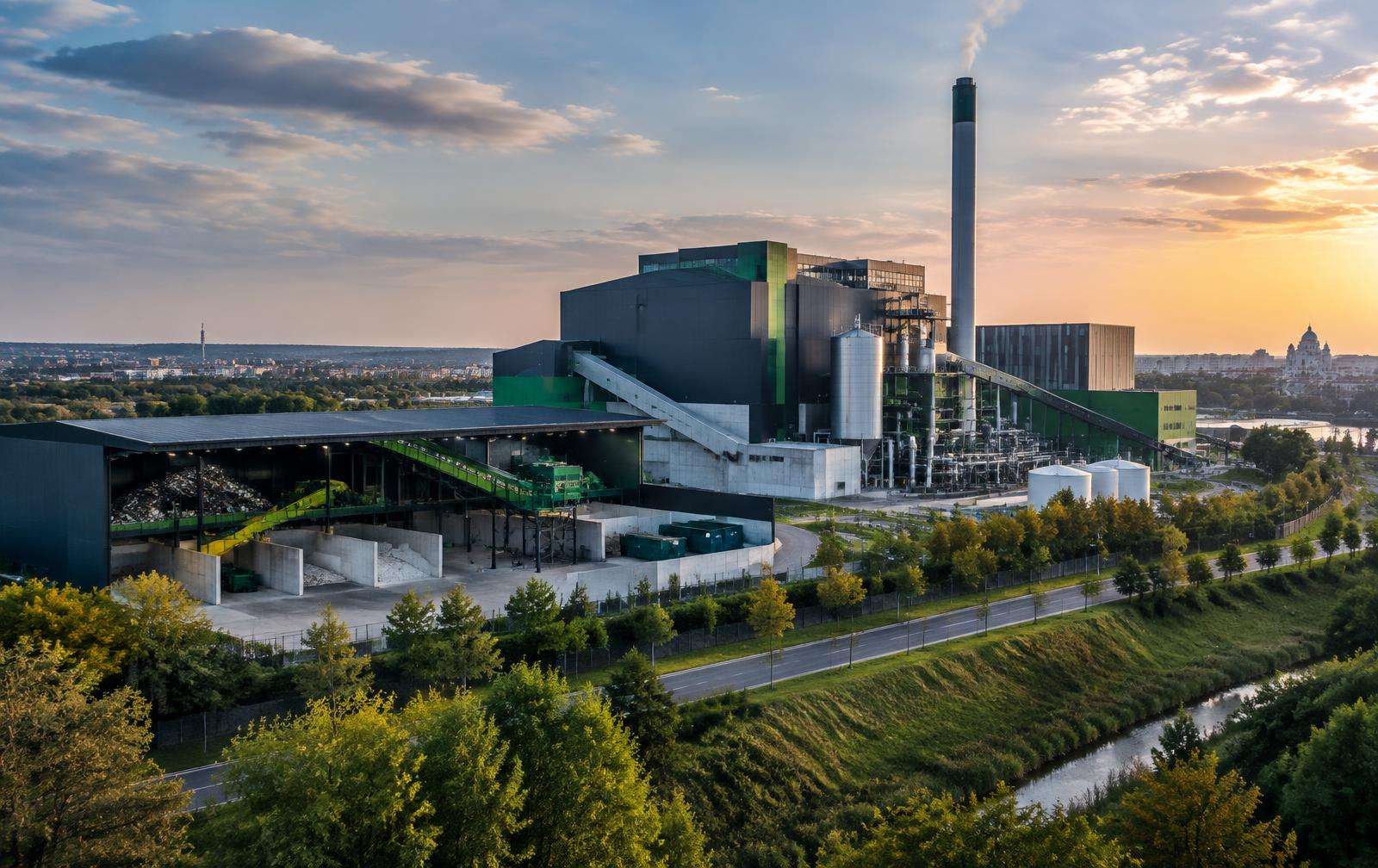
Romania Waste-to-Energy (WtE) market intelligence: European-standard residual waste treatment, energy recovery and material recovery for Romania's next generation of waste infrastructure.
WtE is not a replacement for prevention, reuse or recycling. It is one option for a demonstrably non-recyclable residual fraction after higher-order interventions.
01 — The Romanian challenge
Romania must raise recycling performance while reducing landfill dependency. The difference between both targets is not an incineration quota.
≈12%
recycled in 2023
Approximate municipal-waste recycling rate reported for Romania.
55%
2025 recycling target
EU preparation-for-reuse and recycling target.
60%
2030 recycling target
EU preparation-for-reuse and recycling target.
65%
2035 recycling target
EU preparation-for-reuse and recycling target.
≤10%
2035 landfill limit
EU maximum share of municipal waste sent to landfill.
02 — Where energy recovery fits
Energy recovery belongs within an integrated system, after source separation, sorting, recycling and appropriate biological treatment—not instead of them.
The residual fraction must be demonstrated through representative feedstock and composition studies.
03 — Romania project watch
This tracker distinguishes conventional WtE incineration, RDF/SRF use, biological energy recovery and alternative thermal processes.
Bucharest · Romania
The 2020–2025 planning document evaluated residual energy-recovery scenarios. The requested ~273,000 t/y figure could not be substantiated in the official documents reviewed; the plan records ~283,492 t/y in Alternative 3. Neither figure proves that a new thermal WtE facility has been constructed. Current implementation status: Status under verification.
Timișoara · Romania
The municipality approved feasibility documentation in January 2026. Existing arrangements reference recovery routes for residual outputs after treatment. This entry is not classified as thermal WtE.
Galați · Romania
Current 2026 decisions concern an integrated municipal system. Anaerobic digestion produces biogas and is biological energy recovery; it is not presented here as incineration.
Cluj · Romania
The County reported the installation operating and registered its design with OSIM in May 2026. It is not described as conventional mass-burn incineration. Ministry correspondence reported elsewhere rejected national rollout, so this is shown as a contested single-site case without performance claims.
04 — Why TRS + Overdie
Potential scope is confirmed project by project. Bottom-ash treatment and outlet qualification should be considered during plant design—not added as an afterthought.
TRS BV
Overdie
05 — European compliance by design
Controlled emissions in accordance with applicable permit requirements and Best Available Techniques.
06 — Local value creation
07 — Project development
The best opportunity to protect the waste hierarchy, compare technologies and design resource recovery is before tender requirements are fixed.
Planning residual-waste infrastructure in Romania? Talk to us before the specification is closed.
Start a project conversation08 — Sources
Every material market or compliance claim on this page is attached to a dated source. Unconfirmed implementation is labelled Status under verification.
EUROSTAT-MWRO-2026
Eurostat
Municipal waste reporting obligation — 2023 reference year · 26 March 2026
Approximately 12% municipal-waste recycling in Romania in 2023. The legally binding reporting dataset uses harmonised Waste Framework Directive rules.
Last checked: 18 September 2026
EU-DIR-2018-851-850
European Union
Directives (EU) 2018/851 and 2018/850 · 30 May 2018
Municipal-waste recycling targets of 55% by 2025, 60% by 2030 and 65% by 2035, and a maximum 10% municipal landfill share by 2035.
Last checked: 18 September 2026
EU-WFD-2008-98
European Union
Waste Framework Directive 2008/98/EC, Article 4 · 19 November 2008, consolidated text
The legally established EU waste hierarchy and priority order for waste policy.
Last checked: 18 September 2026
PMB-PGDMB-2020-25
Municipality of Bucharest
Waste Management Plan for Bucharest 2020–2025 · 2021
Historical planning scenarios for residual treatment. The reviewed plan estimates about 283,492 tonnes/year for energy recovery in Alternative 3; it does not establish that a new thermal WtE plant was built.
Last checked: 18 September 2026
PMB-HCL-327-2026
General Council of Bucharest
Decision 327/2026 — Integrated Waste Management Strategy · 2026
Approval of Bucharest's updated integrated waste-management strategy; no reviewed evidence of a newly constructed thermal WtE facility.
Last checked: 18 September 2026
TIMISOARA-HCL-13-2026
Timișoara Local Council
Decision 13/2026 — feasibility documentation for integrated treatment · January 2026
Approval of feasibility documentation for mechanical-biological treatment and biowaste composting. This is not confirmation of a thermal WtE project.
Last checked: 18 September 2026
GALATI-HCL-252-2026
Galați Local Council
Decision 252/2026 — Integrated Waste Management System, Stage II · 2026
2026 implementation decisions for integrated treatment including mechanical-biological treatment, anaerobic digestion and biological energy recovery.
Last checked: 18 September 2026
CLUJ-CJ-2026
Cluj County Council
CMID molecular-disintegration installation registered with OSIM · 15 May 2026
County statement that the single-site installation was operating; it is described separately from conventional mass-burn incineration and no performance claim is inferred.
Last checked: 18 September 2026
CLUJ-MINISTRY-CAVEAT-2026
Cluj24 reporting on Ministry of Environment correspondence
National rollout of Cluj technology not accepted by Environment Ministry · January 2026
The important qualification that the reported Cluj operation is a contested single-site case, not an established national model.
Last checked: 18 September 2026
EU-IED-2010-75
European Union
Industrial Emissions Directive 2010/75/EU · 24 November 2010, amended 2024
The European industrial-emissions framework applying to permitted installations.
Last checked: 18 September 2026
EU-WI-BREF-2019
European Commission Joint Research Centre
Waste Incineration BAT Reference Document · 2019
Best Available Techniques for emissions control and monitoring, energy and resource efficiency, water management, residues and traceability.
Last checked: 18 September 2026
Read how facts, benchmarks, scenarios and project statuses are classified in our methodology and assumptions.
Where TRS + Overdie can create value
Prevention, reuse and recycling come first. These services apply to the residual fraction that remains, in the order of importance relevant for Romania.
01 — Mineral route
Primary role
Primary — supports maximum local material reuse and EU-aligned circularity
Actual reuse depends on material quality, treatment, environmental testing, technical standards and local regulation.
Explore a mineral route02 — Ash scan
Primary role
Secondary — only applies where thermal WtE / IBA exists or is selected
No guaranteed recovery percentage is stated before plant-specific testing.
Assess my bottom ash03 — Metal recovery
Primary role
Third — supports recovery of metals that remain after energy recovery
Subject to material specification and commercial evaluation.
Discuss a metal streamOur technical view
Editorial interpretation by TRS BV and Overdie. It is deliberately separated from verified facts and sourced project data.
Where do you start?
Offtake
Local where possible.
International where it adds value.
International shipment is not promised for every material. Logistics, economics and regulation are assessed per project and per material specification.
Open items
These questions are open per plant and per project. They are answered with the owner or operator, not assumed.
Romania project development