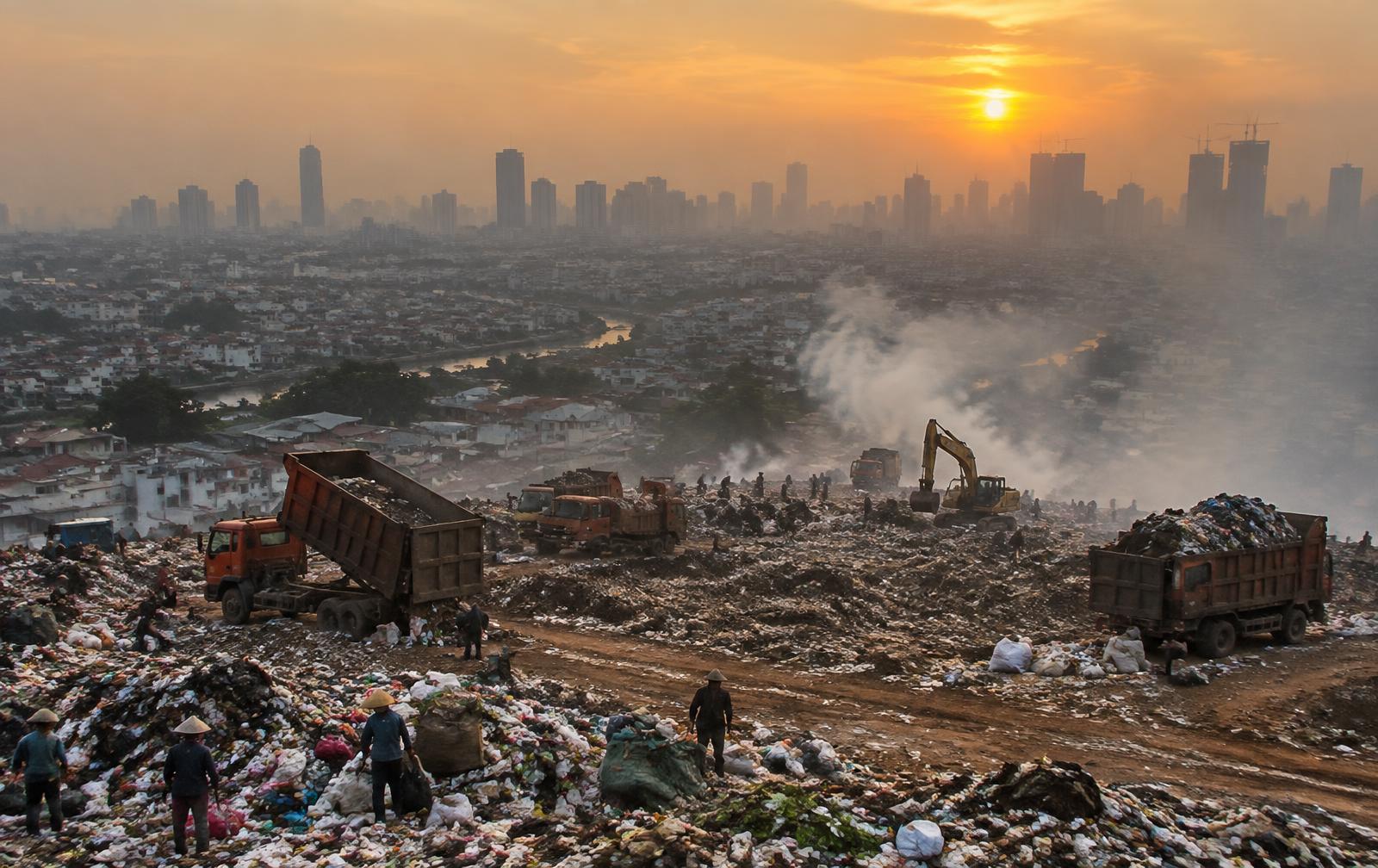
OPEN DUMPSITES
Little or no engineered containment
- Methane emissions
- Landfill fires
- Leachate and contaminated runoff
- Odour and air pollution
- Groundwater and soil risks
- Long-term land occupation
 First activation scrolls to the top of this page. Second activation opens the home page.
What the evidence actually says about methane, land use, emissions, energy and resource recovery.
This is not an argument to burn recyclable material. It examines the role of modern WtE for the non-recyclable residual fraction within an integrated waste hierarchy.
01 — Start with the waste hierarchy
The EU Waste Framework Directive establishes a five-step hierarchy. Energy recovery is below prevention, preparing for reuse and recycling—and above disposal.
Prevention
Preparing for reuse
Recycling
Other recovery, including energy recovery
Disposal
02 — What happens in a landfill?
Organic material decomposes under oxygen-poor conditions and generates landfill gas containing methane. The level of control matters profoundly.
Engineered sites can use liners, controlled cells, leachate collection and treatment, gas collection, monitoring, closure systems and long-term aftercare. Methane still forms, and collection is not necessarily complete, but these sites must not be equated with uncontrolled dumping.
03 — Satellites can now see the methane
Researchers led by SRON combined the European TROPOMI instrument with high-resolution GHGSat observations to identify and quantify strong landfill methane sources.
≈2.6
tonnes CH₄/hour
Delhi facility-level estimate; reported range 1.6–3.8
≈9.8
tonnes CH₄/hour
Mumbai facility-level estimate; reported range 6.1–26.0
≈1.4–2.6×
inventory estimates
Satellite-derived city methane across the four studied urban areas
≈6–50%
of estimated city methane
Attributed to the identified landfills across those four cases
Important limitation
These are observations from specific sites and urban areas. They cannot be extrapolated to every landfill, and they do not describe all engineered sanitary landfills.
04 — What modern WtE changes
For suitable non-recyclable residual waste, modern WtE changes long-term decomposition into a controlled industrial treatment process—but does not make residues disappear.
Municipal waste combustion is often described as reducing original volume by approximately 70–90%. EPA's stated ash range of 5–15% by volume implies approximately 85–95% volume reduction.
The treated biodegradable fraction no longer decomposes over decades in landfill.
Facilities can generate electricity and/or useful heat, depending on system design and local demand.
Ferrous and non-ferrous fractions can be recovered from bottom ash.
The remaining mineral fraction can be treated and assessed for approved secondary uses.
Ash and air-pollution-control residues remain and require management.
05 — WtE also has emissions
Combustion creates carbon dioxide, flue gases, bottom ash and fly ash or air-pollution-control residues.
Modern WtE should be judged as part of the complete waste-management system, not as a zero-emission technology.
06 — After the furnace
Energy recovery is not the end of the process. Bottom ash can become the starting point for metals recovery and mineral upgrading.
REMEX reports average non-ferrous content around 2% in the European incinerator bottom ash it processes. In its experience, approximately 25% of those non-ferrous metals can be below 4 mm. Actual composition depends on the incoming waste, combustion process and plant.
07 — The real comparison
This table does not declare one option universally best. It distinguishes uncontrolled dumping, engineered final disposal and controlled treatment with resource recovery.
| Topic | Open dumping / uncontrolled landfill | Engineered sanitary landfill | Modern WtE + resource recovery |
|---|---|---|---|
| Land requirement | Large and expanding footprint; land is occupied without engineered containment or planned aftercare. | Large footprint with cells, buffers and long-term aftercare; engineered containment manages risk. | Compact treatment footprint relative to untreated disposal, but facilities and residue outlets still require land. |
| Methane generation | Biodegradable waste can generate methane with little or no collection. | Methane still forms; engineered gas collection can capture part of it, with performance varying over time and by site. | Treated residual waste no longer decomposes in landfill; fossil and biogenic CO₂ arise during combustion instead. |
| Energy recovery | Normally none. | Landfill gas may be captured for energy where systems and gas quality allow. | Electricity and/or useful heat can be recovered from suitable non-recyclable residual waste. |
| Metal recovery | Normally absent; mixed materials remain buried. | Limited before disposal unless separate sorting takes place. | Ferrous and non-ferrous metals can be recovered from bottom ash after combustion. |
| Mineral recovery | Normally absent. | Normally absent from the disposed mixed waste. | Bottom-ash mineral fractions may be processed for approved uses, subject to testing and local regulation. |
| Residual volume | Original waste volume remains, with settlement and decomposition over time. | Original waste volume remains, usually compacted within engineered cells. | A commonly used approximate range is 70–90% volume reduction; EPA's ash-volume figures imply approximately 85–95%. Ash and treatment residues remain. |
| Long-term liability | High and poorly bounded where records, containment and aftercare are absent. | Requires decades of monitoring, gas and leachate management, closure and aftercare. | Plant obligations are operationally intensive; residues require controlled treatment, outlets and disposal. |
| Air emissions | Diffuse methane, odour, dust and smoke; fires can create acute pollution. | Diffuse landfill gas remains possible; collection and flaring or use can reduce releases. | Stack emissions and CO₂ require flue-gas treatment, continuous monitoring, permitting and BAT. |
| Water / leachate management | Uncontrolled runoff and leachate can threaten soil and water. | Liners, drainage, collection and treatment are core engineered controls. | Process water and residues require controlled management; bottom-ash storage and processing must protect water. |
| Capital requirement | Low apparent upfront cost, with environmental and social costs transferred into the future. | Moderate to high when fully engineered, operated, closed and monitored. | High upfront capital requirement, plus long-term maintenance and emissions-control costs. |
| Operational complexity | Low formal control; high unmanaged risk. | Requires professional cell operation, gas and leachate systems, monitoring and aftercare. | High: continuous process control, skilled operation, emissions systems, maintenance and residue management. |
For dense regions with large quantities of non-recyclable residual waste, limited landfill space and appropriate environmental regulation, modern Waste-to-Energy can be an important part of an integrated waste-management system.
08 — Why this matters for fast-growing cities
Rapid urbanisation creates a long-term infrastructure challenge. A city cannot solve it by simply finding the next piece of land for dumping.
Waste should be managed as a resource system — not as a pile that moves from one location to another.
09 — Sources
Scientific evidence, government and regulatory sources, and industry operating benchmarks are separated. Industry data is not presented as independent science.
Science Advances
SCI-METHANE-2022
Using satellites to uncover large methane emissions from landfills
10 August 2022
Satellite detection and quantification of large methane emissions at selected landfill sites; results are site-specific.
Open sourceSRON Netherlands Institute for Space Research
SRON-METHANE-2022
Targeting waste emissions observed from space
10 August 2022
Plain-language explanation of combined TROPOMI and GHGSat observations over landfill sites in Buenos Aires, Delhi, Lahore and Mumbai.
Open sourceEuropean Union
EU-WFD-2008
Directive 2008/98/EC on waste
19 November 2008
EU waste hierarchy and the priority of prevention, reuse and recycling before other recovery and disposal.
Open sourceEuropean Commission Joint Research Centre
EU-WI-BREF-2019
BAT Reference Document for Waste Incineration
December 2019
Best Available Techniques for waste incineration, emissions control, monitoring, energy efficiency and residues.
Open sourceUnited Nations Environment Programme
UNEP-OPEN-DUMPING
Open dumping
Current programme reference
Environmental and public-health risks associated with uncontrolled open dumping, including air, water and soil pollution.
Open sourceUnited States Environmental Protection Agency
US-EPA-MWC
Energy Recovery from the Combustion of Municipal Solid Waste
Current government reference
EPA reports combustion ash at approximately 5–15% by volume of processed MSW, implying about 85–95% volume reduction; ash and other residues still require management.
Open sourceOperational references only. These values are not universal and are not independent scientific evidence.
REMEX Mineralstoff GmbH
REMEX-FINE-NF
MERIT benefit — Metal recovery
Current industry reference
European operating experience reporting around 2% non-ferrous metals in processed IBA on average and approximately 25% of that non-ferrous content below 4 mm; actual ash composition varies.
Open sourceRead how facts, benchmarks, scenarios and project statuses are classified in our methodology and assumptions.
After energy recovery
The residual circular economy
TRS and Overdie work on the residual part of the circular economy — where waste can still become energy, metals and usable mineral resources.